
Visually Impaired Athlete running in the St George Marathon |
A blind marathon runner supported by running guides |
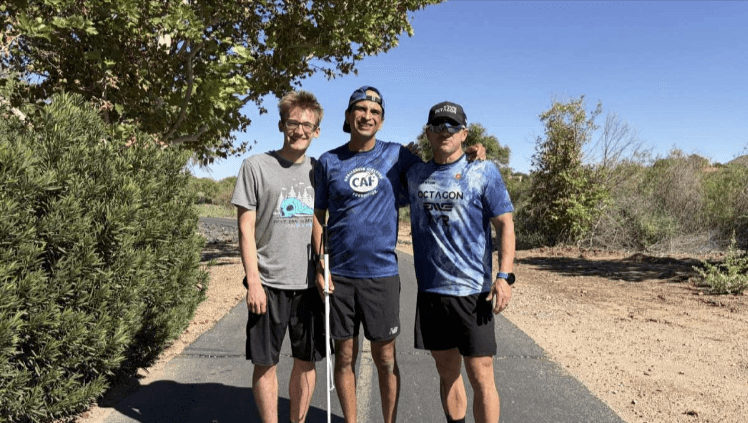
On the St. George Marathon course, a blind marathon runner depends on more than endurance to keep moving toward the finish.
For Adrian Broca, the right marathon running guides must match his pace while helping him navigate the course.
That partnership has brought the California runner back to St. George, where earlier races left him eager to return.
Broca has completed marathons for decades, including a 2-hour, 50-minute performance in St. George in 2007.
His speed makes one point clear: The guides are there to support his race, not run it for him.
During a return to the event, Utah runners Nate Zarlengo and Sean Feeny planned to share that responsibility.
Zarlengo would guide the first half, with Feeny taking over for the stretch to the finish.
Broca and Zarlengo have raced together before, using a short tether around their wrists to stay connected.
The arrangement demands steady communication and a guide strong enough to maintain Broca’s pace through the miles.
Broca’s path into distance running began when he started losing his sight as a teenager.
After learning he had Leber’s hereditary optic neuropathy, he faced a painful period of depression and uncertainty.
His brother encouraged him to try cross-country, offering a first glimpse of what running might still make possible.
As his vision worsened, Broca left the team, but he eventually returned to running near his family’s home.
Familiar routes helped him rebuild confidence, while friends and relatives accompanied him into less familiar territory.
He entered his first marathon without a guide and later learned how much a running partner could help.
Since then, he has qualified for the Boston Marathon multiple times and competed in triathlons.
Those achievements speak to Broca’s training as much as they do to the people willing to run beside him.
In St. George, visually impaired athletes like Broca also challenge assumptions about who belongs on a marathon course.
A guide can call out a turn or help hold a line, but every stride remains the athlete’s own.
Broca hoped his St. George effort would improve his Boston qualifying time, aiming for a finish near three hours and ten minutes.
Just as important, he wanted others facing a difficult change to see that their goals need not disappear.
His story is not about ignoring a loss.
It is about finding a way forward, one shared mile at a time. |
23 Comments
Join the conversation
Hope someone at the finish line got a photo of him crossing. That would be worth framing.
The part about him running familiar routes near home to rebuild confidence really stuck with me. Small steps matter.
Tina MoralesSame. There's something really honest about that detail. He didn't jump straight back to racing, he just started with what was familiar. Makes the whole story feel more real.
Really cool to see California runners making the trip to St George just for this race. Says a lot about the course.
Greg L.Right? The St George course draws people from all over. The downhill stretch alone makes it worth the drive from California honestly.
I tried running with a friend once while she had her eyes closed just for fun and we lasted about 30 seconds. These guys are incredible.
amy_runsHa, 30 seconds is probably generous. I tried something similar and walked straight into a curb. The coordination these guys have is on another level.
The guides deserve a lot of credit too. Keeping someone else's pace for 13 miles is no small thing.
People always underestimate visually impaired athletes. This is a good reminder of that.
Sandra K.Totally agree. A sub 3 hour finish in 2007 and people still act surprised when they hear he's competitive. The results speak for themselves.
Switching guides at the halfway point is interesting. Wonder how the handoff actually goes mid race.
JaredUI've seen guide handoffs at other races and it's pretty smooth when they've practiced it. They usually slow just slightly and transfer the tether. Takes a lot of trust though.
Never heard of Leber's hereditary optic neuropathy before. Going to look that up.
Carolyn F.It's a genetic condition that affects the optic nerve. My cousin was diagnosed with it a few years ago. Hits young people a lot, which makes it especially hard.
I ran St George last year and that course is no joke even with full vision. Respect.
His brother encouraging him to try cross country when he was losing his sight, that got me.
Good luck to him on that Boston qualifier. 3:10 on the St George course is very doable.
Tom_WSt George is a fast course for sure. If he's in good shape coming in I'd say he has a solid shot. Fingers crossed for him.
I volunteer at the marathon every year and seeing the guide runners in action is honestly one of the best parts of the day.
Nate Zarlengo is a great guy. Not surprised he stepped up to do this.
The tether idea is so smart. Never thought about how that works logistically.
Rachel M.It works really well from what I've seen at races. The tether keeps them close without being restrictive. Communication is still the harder part I think.
That 2:50 in 2007 is seriously fast. Most sighted runners would kill for that time.