
Drought and Climate Change Reshape Southern Utah's River Recreation |
Low water levels in the Colorado and Virgin Rivers challenge local businesses and prompt policy reevaluation |
 |
Southern Utah's rivers, once the lifeblood of agriculture and industry, now fuel vibrant recreational economies.
However, recent years have seen these waterways, particularly the Colorado River and its tributaries, experience unprecedented low flows, profoundly impacting local businesses and communities.
In the past two decades, the Colorado River has recorded its lowest sustained flows at the Cisco gauge, situated downstream of the Dolores River near Westwater Canyon.
Dr. John (Jack) Schmidt, director of the Center for Colorado River Studies at Utah State University, noted that during the periods from 2002 to 2004 and 2020 to 2022, flow levels were approximately 50% of those observed between 2005 and 2019.
He attributes these declines to a combination of climate change and human activities, including the operations of reservoirs like McPhee, which have significantly reduced inflows from the Dolores River.
For local outfitters, these changes manifest in altered bookings, cancellations, and the need to adjust itineraries.
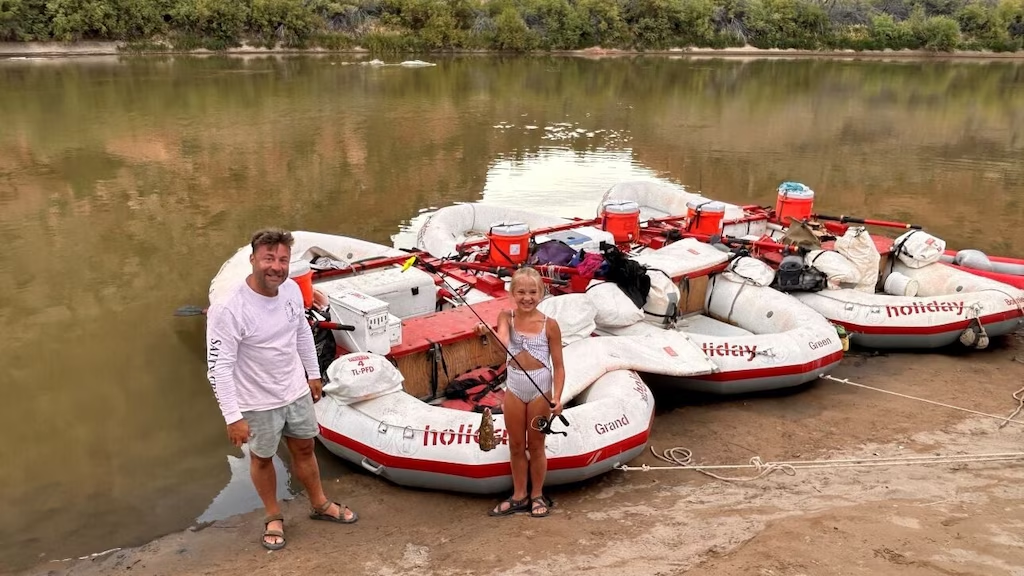
Lauren Wood of Holiday River Expeditions observed that while low water isn't new, the increased frequency of drought years has necessitated operational adjustments.
To accommodate lower flows, the company has extended its longer trips by a day during midsummer, ensuring guests don't miss out on the region's remarkable hiking opportunities.
The San Juan River, a tributary of the Colorado River, has become particularly unpredictable.
Wood highlighted that if tributaries like the Animas River aren't flowing adequately, the San Juan can drop below navigable levels, often requiring trips to be relocated.
Infrastructure challenges further complicate operations.
Wood pointed out the slow progress in developing new ramps, leaving boaters to rely on makeshift takeouts like the sediment slope known as 'North Wash.'
She emphasized the need for collaborative efforts and a reevaluation of longstanding water policies, suggesting it's time to radically reimagine our relationship with the Colorado River.
Closer to Zion National Park, tubing operators on the Virgin River face their own set of challenges.
Adam Freeman, owner of Zion Tubing, recounted that 2025 began with record-low snowpack, leading to concerns about the viability of the tubing season.
Surprisingly, the river maintained levels around 50 cubic feet per second, a record low since the company's inception in 2019.
Despite these conditions, the river remained safe for tubing, and business stayed steady.
However, rising operational costs have posed additional challenges.
Freeman noted significant price increases in equipment, prompting the company to focus on repairing rather than replacing gear to keep prices stable for customers.
Safety remains a top priority, with the team closely monitoring U.S. Geological Survey data and weather models to make informed decisions during the monsoon season.
These ongoing challenges underscore the pressing need for comprehensive water management strategies.
As the Colorado River Compact approaches its centennial, stakeholders are calling for a reevaluation of water-sharing agreements to address the realities of a changing climate and its impact on vital waterways.
In the face of these challenges, the resilience and adaptability of Southern Utah's river communities offer a beacon of hope.
Through collaboration and innovation, they continue to navigate the complexities of a shifting environment, striving to preserve the recreational and economic lifeblood that these rivers provide. |